
At the Tahirih Justice Center, our interdisciplinary model combines legal representation with social services, and the experiences of the survivors we serve inform and shape our advocacy and policy work. Through this direct service work, we see firsthand that legal representation alone is not enough: for immigrant survivors of gender-based violence, safety, stability, and healing are deeply interconnected.
Access to healthcare, including mental health services, is an important part of any path forward. Yet we also see the significant barriers immigrant survivors can face in getting the care they need, from navigating an unfamiliar healthcare system to finding services that are accessible, affordable, and responsive to their experiences.
For more than five years, Tahirih’s Houston team has worked with survivors, healthcare providers, researchers, and community partners to better understand those barriers and identify practical solutions. From navigating the healthcare system and expanding access to culturally responsive mental health services to addressing growing fears around immigration enforcement, Tahirih hopes this research will build awareness and provide practical tools that providers and immigrants can use to better understand healthcare access needs in Houston, Texas.
Our work to improve access to healthcare for immigrant survivors is ongoing. We work closely with partners across Houston, Texas, and the United States to identify and seize opportunities for policy change, collaborative solutions, and empowerment of immigrant survivors to improve resources in their communities.
Explore the research, resources, and tools we’ve developed to help immigrant survivors and their families access healthcare with greater confidence and safety.
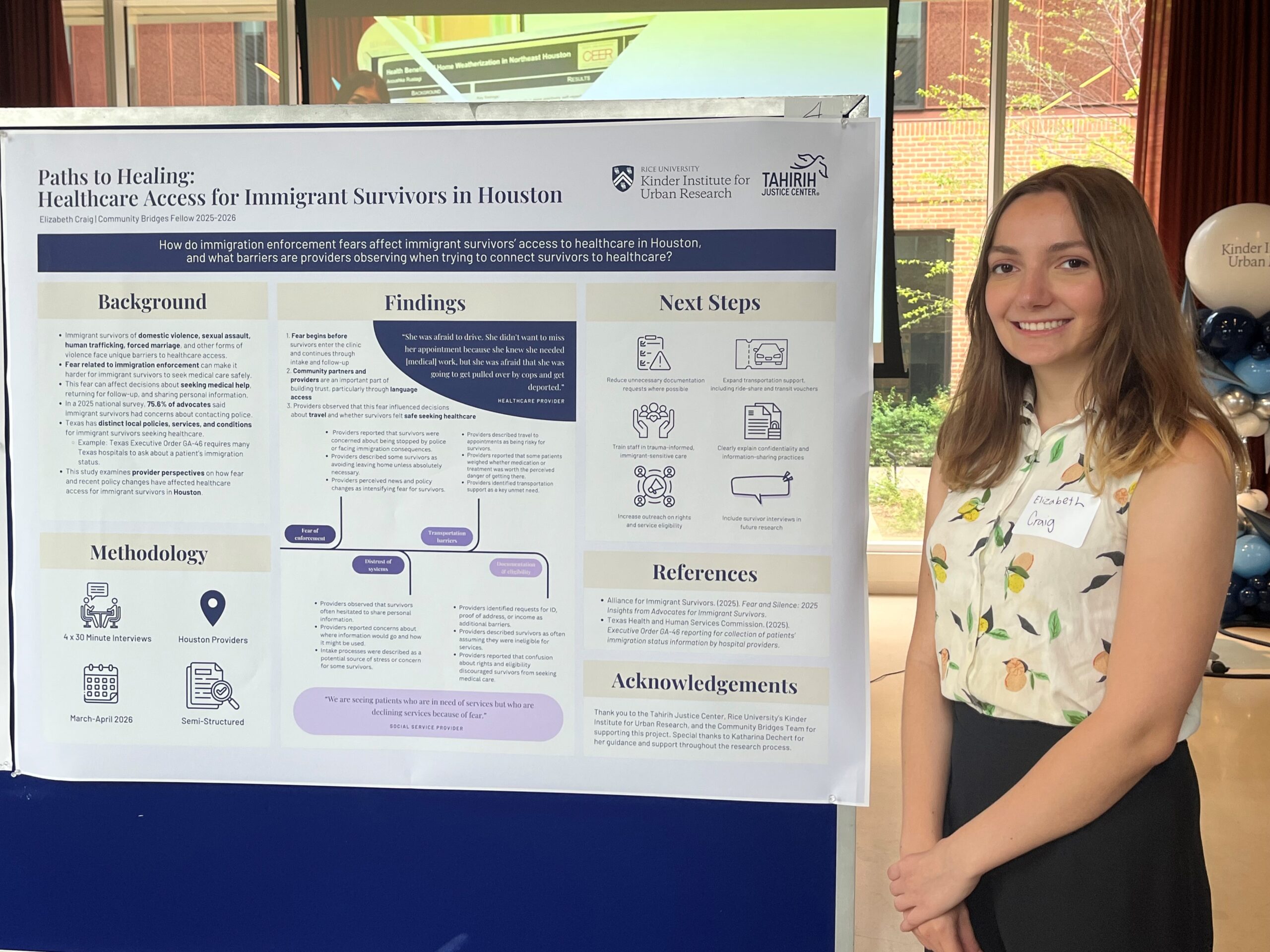
2026: Paths to Healing: Healthcare Access for Immigrant Survivors in Houston
Because significant policy changes affected immigrant survivors in 2025, Tahirih partnered with Rice University’s and Kinder Institute’s Community Bridges Program to examine how these changes affected healthcare access. We saw that fears of detention, deportation, and family separation increasingly affected immigrant survivors’ decisions about seeking healthcare. Paths to Healing: Healthcare Access for Immigrant Survivors in Houston identifies opportunities to preserve access to care, including stronger patient privacy protections, expanded telehealth and transportation support, and policies limiting immigration enforcement at healthcare facilities and other critical locations.
Special thanks to 2025-2026 Kinder Institute/Rice University Fellow Elizabeth Craig.
Download Paths to Healing Flyer
2026: Educational Videos Related to Healthcare
To address fear and misinformation that can prevent immigrant survivors and their families from seeking healthcare, Tahirih partnered with Rice University’s Foreign Language Program to develop a series of educational videos in English, Spanish, and Arabic. The series provides clear, accessible information about language access, patient privacy, interactions with immigration authorities at healthcare facilities, changes to healthcare access, and culturally responsive mental health services—helping immigrant survivors better understand their rights and make informed decisions about their care.
Special thanks to Rice University student Nikitha Kota, Dr. Hélade Scutti Santos, Dr. Hossam Elsherbiny, Professor Liang Fu, Professor Thais Diaz-Montalvo, Professor Aymará Boggiano, and Dr. Melissa Bailar with Rice University, and the many students who worked to produce these videos.
Watch the Videos
- Language Access in Healthcare
- Healthcare Privacy: Understanding What Healthcare Providers are Prohibited from Sharing
- Interactions with Immigrant Authorities at Healthcare Centers in Texas
- Information on the Changes to Healthcare Access in the 2025 Budget Reconciliation Bill
- Accessing Culturally Competent Mental Healthcare in Houston
We hope these videos help immigrant survivors and their families better understand their rights and feel confident making decisions about accessing healthcare.
2025: Beyond the Western Lens: A Study of Culturally Rooted Mental Health Practices in the Houston Area
Recognizing that traditional talk therapy may not meet the needs of immigrant survivors from diverse cultural backgrounds or be easily accessible due to language barriers, transportation difficulties, and financial access, Tahirih partnered with Rice University’s and Kinder Institute’s Community Bridges Program to explore culturally rooted approaches to mental health and healing. Beyond the Western Lens: A Study of Culturally Rooted Mental Health Practices in the Houston Area examines opportunities to expand access to culturally responsive care and includes community resources in English, Spanish, and Arabic to help survivors identify providers and approaches that meet their needs.
Special thanks to 2024-2025 Kinder Institute/Rice University Fellow Nikitha Kota.
Read the Report: Beyond the Western Lens
For individuals:
Download a Guide to Culturally Rooted Healing
2024: Mental Health Services for Immigrant Survivors of Violence: Community Resource Mapping
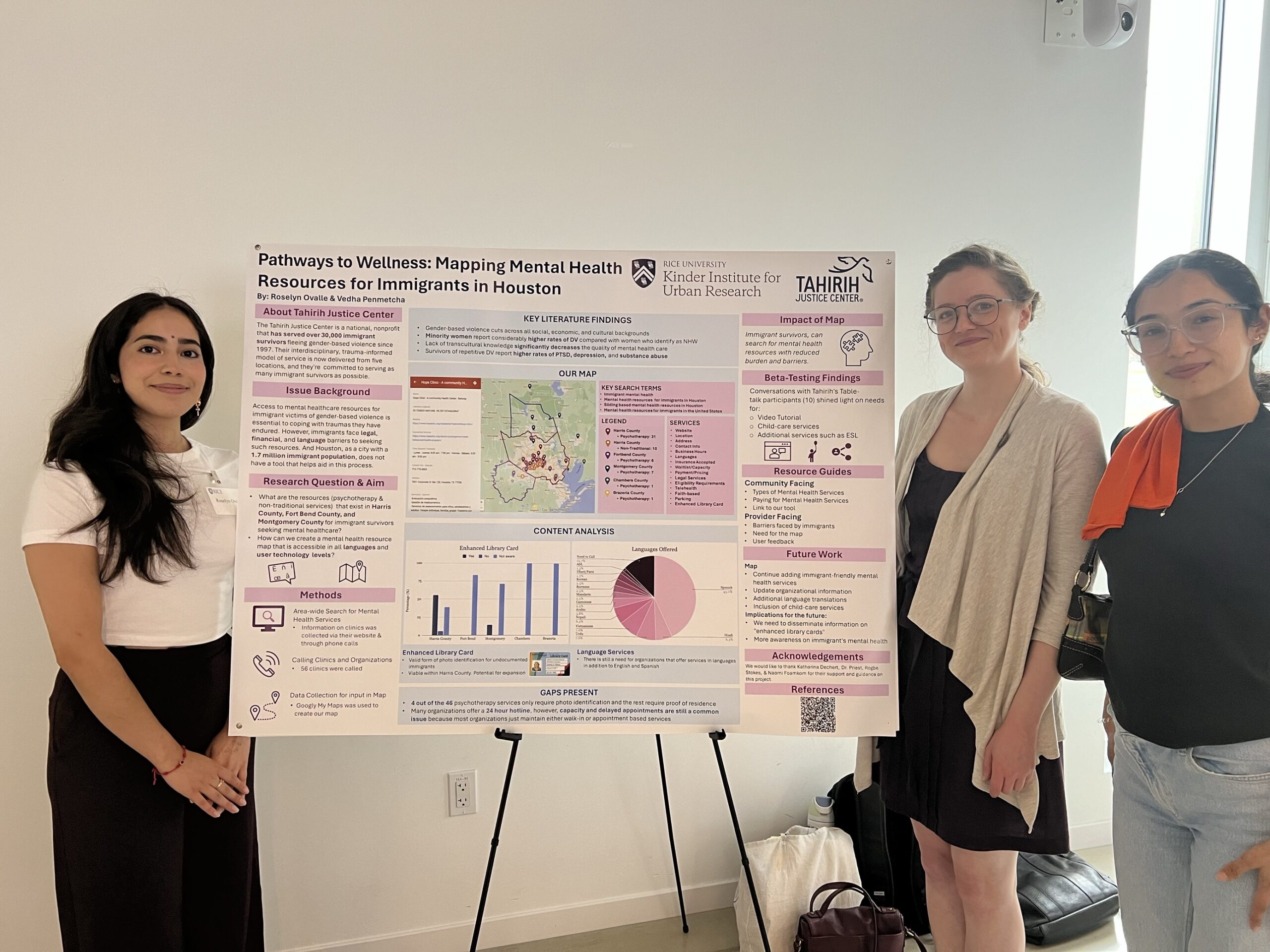
Building on our healthcare access research, Tahirih partnered with Rice University’s and Kinder Institute’s Community Bridges Program and survivor advocates to examine barriers to mental health services for immigrant survivors of violence. The resulting provider guide and bilingual resource maps help survivors and their families identify accessible mental health resources while highlighting practical barriers—including childcare, waitlists, referral requirements, and eligibility rules—that can make care difficult to access.
Special thanks to 2023-2024 Kinder Institute/Rice University Fellows Roselyn Ovalle and Vedha Penmetcha.
Read our blogpost: Pathways to Wellness: Mapping Mental Health Resources for Immigrant Survivors of Gender-Based Violence in Houston
Read the Report: Mental Health Services Community Resource Mapping
Download the English Brochure: Mental Health and Immigration
Download the Spanish Brochure: Salud Mental e Immigracion
2022/2021: Addressing the Healthcare Needs of the Immigrant Community in the Greater Houston-Galveston Area
To better understand the barriers Houston’s immigrant communities face when seeking healthcare, Tahirih conducted research examining how people access care and what influences their decisions. Addressing the Healthcare Needs of the Immigrant Community in the Greater Houston-Galveston Area identified barriers including language, cost, transportation, childcare, and limited awareness of available resources, and offers practical tools and recommendations for healthcare providers and immigrant patients.
Special thanks to Weil Legal Innovator Fellow Sofia Barbosa.
Read the Report: Addressing the Healthcare Needs
For Providers:
Download Best Practices One Pagers
For Patients (English version):
Download the English Brochure: Navigating the American Healthcare System
2021: A System Under Stress: The Impact of the COVID-19 Pandemic on Non-Detained Cases in Immigration Courts
As the COVID-19 pandemic disrupted immigration courts across the country, immigrant survivors faced court closures, shifting policies, mounting delays, and new barriers to accessing due process. With support from the Weil Legal Innovators Program, Tahirih examined the pandemic’s impact on non-detained immigration cases. In March 2021, we published A System Under Stress: The Impact of the COVID-19 Pandemic on Non-Detained Cases in Immigration Courts, which documented the challenges immigrants and their attorneys faced in staying healthy and accessing due process, as well as the growing backlogs and delays affecting immigrant survivors and safety. While courts have since reopened, the effects of those backlogs and the pandemic’s broader impact on immigrant communities and the healthcare system continue today.
Special thanks to Weil Legal Innovator Fellow Julia Bevan.
Read the Report: A System Under Stress